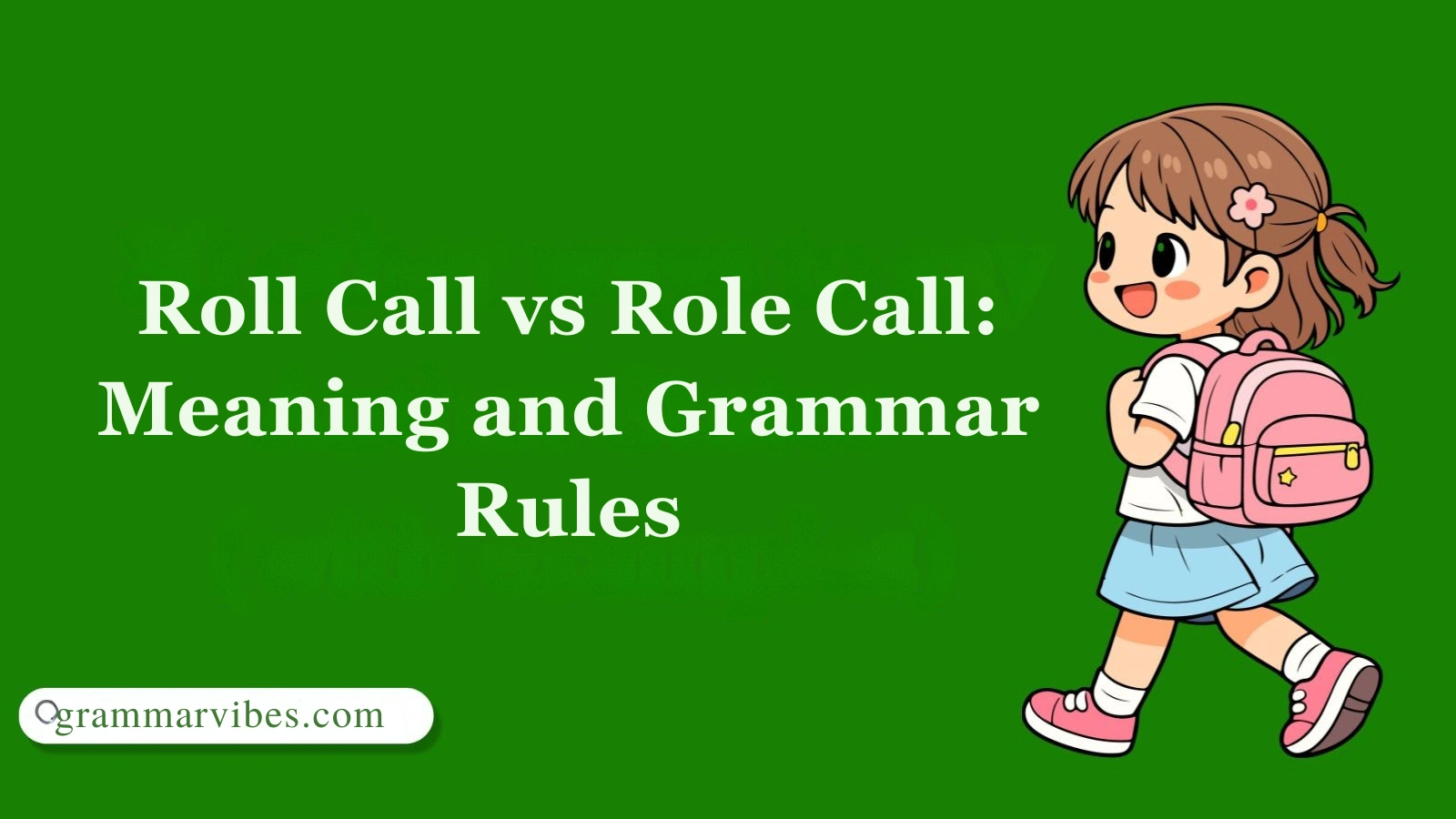

Roll Call vs Role Call is often confusing in every day school life where students, participants, and teachers deal with words and phrases that are sound alike but have different meanings in English. In daily use, I have seen English learners, native speakers, and writers face confusion and challenges while doing checking attendance, calling out names, and working in classroom or meeting with second-guessing of the right word in different situations.
In real classroom management and organizational procedures a register, list, or attendance sheet is used for attendance tracking, where participants’ attendance is handled by record keepers, leaders, and facilitators through verifying and confirm steps. This includes marking presence, identifying, present, ensuring accuracy, clarity, clarity in speech, clarity in writing, proper pronunciation, proper identification, and student accountability in schools with attention, focus, systematic procedures, and careful use of language skills and phonetics.
The correct term is Roll Call, while Role Call refers to a role, part, character, function, or actor, showing clear distinction, homophones, and semantics in spelling, meaning, and avoiding writing mistakes, careless writing, and incorrect usage. Understanding context, choosing, correct, and right word reduces confusion, improves accuracy, and prevents errors in phrase usage, including roll model and role model in schools and meeting settings.
Why “Roll Call vs Role Call” Confuses So Many Writers
The confusion between roll call vs role call comes down to sound, not meaning.
Both words sound identical when spoken. That’s the first trap. English is full of homophones, and this pair is one of the most misleading.
The homophone problem
- Roll and role sound exactly the same in most accents
- Your brain relies on sound first, spelling second
- That leads to automatic but incorrect writing
Why speech-to-text makes it worse
Modern tools often misinterpret spoken input:
- “roll call” becomes “role call”
- “role model” becomes “roll model”
You might not even notice until someone corrects you.
Where the confusion shows up most
- Classroom attendance notes
- Military or sports reports
- Social media captions
- Workplace chat tools like Slack or Teams
The issue is widespread, but the fix is simple once you understand meaning instead of sound.
What “Roll Call” Actually Means (And Why It Exists)
Let’s make this crystal clear: roll call refers to the process of checking attendance by reading out names.
Definition of Roll Call
Roll call = a verbal list of names used to confirm presence
It is used in:
- Schools
- Military formations
- Courtrooms
- Corporate meetings
- Conferences and formal events
Where the word “roll” comes from
The word roll originally referred to a rolled-up list or register. Think of old parchment scrolls used to record names.
So when someone says “roll call,” they literally mean:
“We are calling names from the list.”
How roll call works in real life
Here’s a simple breakdown:
- A list of names is prepared
- Each name is called out
- People respond “present” or “here”
- Attendance is recorded
It sounds simple, but it’s a system used worldwide for accountability.
Why “Role Call” Is Incorrect
Now let’s tackle the mistake: role call.
At first, it sounds logical. You might think:
“Maybe it means calling out people’s roles?”
That assumption is understandable, but linguistically wrong.
What “role” actually means
A role refers to:
- A job or responsibility
- A function in a system
- A character in a play or film
Examples:
- Team leader role
- Actor’s role in a movie
- Parent’s role in a family
Why “role call” doesn’t work
If you say “role call,” you are essentially saying:
“calling out responsibilities”
That has nothing to do with attendance.
Where the mistake usually appears
- “Role call in class” instead of “roll call”
- “We did role call this morning”
- “Teacher started role call”
It looks harmless, but in formal writing, it signals weak grammar awareness.
Roll Call vs Role Call: Real Sentence Examples
Seeing usage in context makes the difference stick.
Correct usage of roll call
- The teacher began roll call at 8 a.m.
- Everyone was present during roll call.
- The officer conducted roll call before duty started.
Incorrect usage (role call)
- ❌ The teacher began role call at 8 a.m.
- ❌ We missed role call this morning.
Even though the second set “sounds right,” it is grammatically incorrect.
Quick comparison table
| Phrase | Correct? | Meaning | Example |
| Roll call | Yes | Attendance check | Roll call before class |
| Role call | No | Incorrect usage | Not valid in standard English |
Role Model vs Roll Model: The Second Common Trap
Once you understand roll call vs role call, another mistake shows up: role model vs roll model.
What “role model” means
A role model is someone who sets an example for others.
Used in:
- Education
- Sports
- Leadership
- Personal development
Examples:
- “She is a role model for young athletes.”
- “He became a role model in his community.”
Why “roll model” is wrong
There is no concept of a “roll model” in English. It likely appears due to:
- Fast typing
- Speech recognition errors
- Mishearing “role”
Memory trick that actually works
- Role = responsibility
- Model = example to follow
Put together:
A role model is someone whose role you want to model.
Simple and logical.
Difference Between “Roll” and “Role” Explained Clearly
Understanding roll call vs role call becomes easier when you separate the root words.
Meaning of “Roll”
“Roll” has multiple meanings:
- A list (as in roll call)
- To move by turning over
- A bread item (dinner roll)
Examples:
- Roll call attendance
- Roll a ball
- Eat a bread roll
Meaning of “Role”
“Role” always relates to function or identity.
Examples:
- Job role
- Actor’s role
- Social role
Side-by-side comparison
| Word | Core Meaning | Common Use |
| Roll | List, movement, food item | Roll call, rolling object |
| Role | Function or responsibility | Role model, job role |
Core Grammar Lessons Behind the Confusion
This isn’t just about two words. It reveals how English actually works.
Homophones cause most spelling mistakes
Words that sound identical often confuse writers:
- roll / role
- their / there
- to / too
Meaning always beats sound
If you rely only on pronunciation, errors increase.
Context is your strongest clue
Ask yourself:
“Am I talking about attendance or responsibility?”
That answer solves the problem instantly.
Most Common Mistakes and How to Avoid Them
Let’s break down real-world patterns.
Frequent errors
- Writing “role call” in attendance notes
- Using “roll model” instead of “role model”
- Trusting autocorrect blindly
Why these mistakes stick
- Fast typing habits
- Lack of proofreading
- Over-reliance on spoken English
Simple correction strategies
Strategy 1: Meaning check
Replace the word with its meaning:
- Attendance check → roll call
- Responsibility → role
Strategy 2: Association trick
- Roll = list rolls out
- Role = job role
Strategy 3: Slow read method
Read your sentence aloud. If it feels off, it probably is.
Case Study: How One Small Error Changes Professional Writing
A school administrator once sent a notice:
“All students must attend role call at 8:00 a.m.”
It went unnoticed at first. But parents flagged it, and the message spread online as an example of poor grammar in official communication.
What went wrong
- The intent was correct
- The spelling weakened credibility
- The error reduced trust in the message
Corrected version
“All students must attend roll call at 8:00 a.m.”
Small change. Big difference in professionalism.
This shows how roll call vs role call isn’t just academic. It affects perception.
Quick Glossary of Related Grammar Terms
Understanding related terms helps reinforce learning.
- Homophone – Words that sound the same but differ in meaning
- Attendance – Presence at an event or place
- Register – Official list of names
- Misuse – Incorrect use of a word or phrase
- Context – Words surrounding a term that define meaning
Read More: Differential vs. Deferential: The Complete Guide
Practical Writing Tips to Avoid These Mistakes Forever
Here’s how you make the correction stick long-term.
Tip 1: Focus on meaning first
Don’t start with spelling. Start with intent.
Tip 2: Build mental word pairs
- Roll = attendance list
- Role = responsibility
Tip 3: Use writing repetition
Write correct sentences multiple times:
- “Roll call started at 9 a.m.”
- “He is a role model for students.”
Tip 4: Slow down before sending
One extra second of review prevents most errors.
Tip 5: Train your brain with contrast
Compare:
- roll call ❌ vs role call ❌
- role model ❌ vs roll model ❌
Then correct them actively.
FAQs
Q1. What is Roll Call used for?
Roll Call is used to check attendance by calling names from a list in schools, meetings, and classrooms.
Q2. Is “Role Call” correct in attendance checking?
No, “Role Call” is incorrect when talking about attendance. The correct term is Roll Call.
Q3. Why do people confuse Roll Call and Role Call?
They sound similar, which creates confusion for English learners and native speakers in daily use.
Q4. What does “Role” mean in Role Call?
“Role” means a part, character, or function someone performs, not attendance checking.
Q5. Where is Roll Call commonly used?
It is commonly used in schools, classrooms, sessions, meetings, and other organized gatherings.
Conclusion
Understanding the difference between Roll Call and Role Call helps improve clarity in English communication. Roll Call is linked to attendance tracking, while Role Call refers to a role or function. Knowing this distinction reduces confusion, avoids common mistakes, and supports better accuracy in speaking and writing during daily school and meeting situations.